
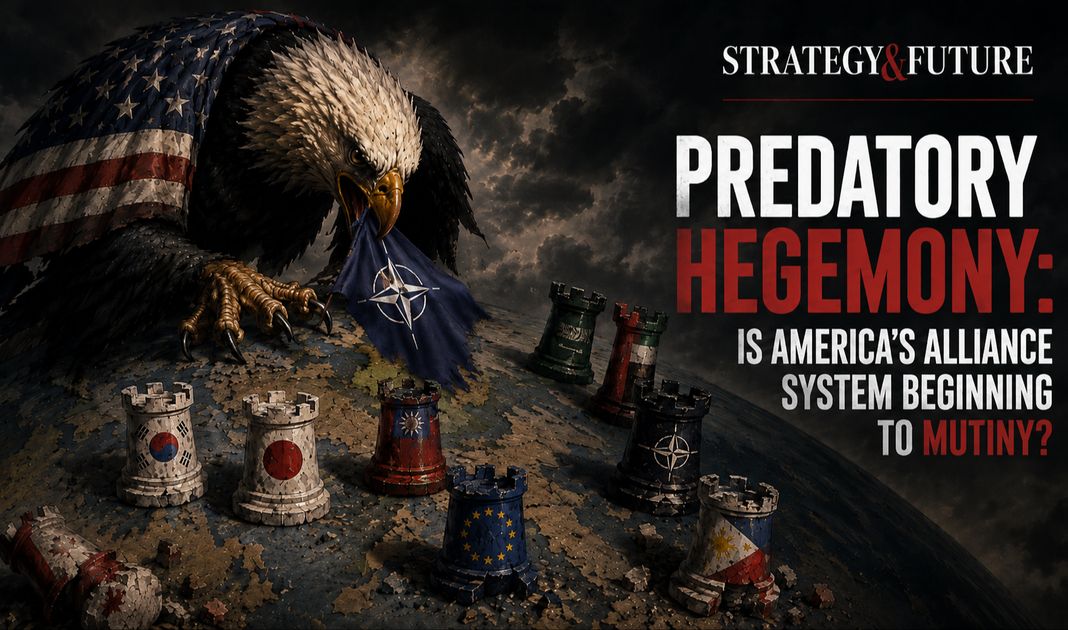
Predatory Hegemony: Is America’s Alliance System Beginning to Mutiny?

8/2026 Jacek Bartosiak, Albert Świdziński
Strategy&Future
The United States is moving away from the grand strategy of primacy that defined the post-Cold War period, but it still wants many of the privileges that primacy once provided. For decades, the American alliance system rested on a relatively simple bargain: the United States provided security, military presence and access to its extraordinary strategic capabilities, while its allies accepted varying degrees of political dependence, bought American weapons, supported the broader U.S.-led international order and, in many cases, helped sustain the financial architecture underpinning American power.
That bargain is now changing. Whether the United States is ultimately moving toward offshore balancing, restraint or something even more isolationist remains unclear, but it is increasingly evident that Washington wants to reduce the costs associated with maintaining its alliance system while continuing to enjoy many of its benefits. This produces what Stephen Walt has described as a form of predatory hegemony: an increasingly transactional system in which alliances are treated more and more as zero-sum relationships and in which the hegemon attempts to extract maximum concessions from partners while assuming fewer obligations of its own. The question is how long such a system can survive. Recent developments in South Korea, the Persian Gulf, Canada and Europe suggest that some American partners may already be reaching the limits of what they are willing to accept. The most striking recent example comes from South Korea. President Donald Trump publicly questioned the logic of continuing the traditional pattern of U.S.–South Korean military exercises, arguing that they were unnecessarily provocative toward North Korea and excessively costly for the United States. He also linked his dissatisfaction to Seoul’s unwillingness to provide the political or military support he had expected. The message was difficult to miss: abandonment is an option. The logic resembles the old Chinese proverb, “kill the chicken to scare the monkey.” South Korea was not necessarily the only intended audience. Washington was signaling to American allies around the world that they must support U.S. policy, shoulder more of the burden and align themselves politically with Washington or risk seeing American protection reduced. What was unusual was South Korea’s response. President Lee did not panic or immediately demand reassurance. Instead, he argued that South Korea was capable of defending itself, pointing to the scale of its military expenditure relative to the entire North Korean economy, and suggested that a reduced American military footprint and fewer exercises could actually improve the prospects for dialogue with Pyongyang. In effect, Seoul responded to the threat of abandonment by saying that perhaps it would not be so bad. For an alliance system built partly on the assumption that allies will continuously demand more American protection, this is potentially significant. South Korea’s strategic environment has changed. It is increasingly capable of dealing with North Korea using its own resources, while excessive identification with Washington’s confrontation with China may itself generate risks for Seoul. Under such circumstances, American military presence can cease to be an unquestioned strategic asset and become, at least partially, a liability.
This leads to the broader paradox of American hegemony. An overwhelming U.S. security commitment can create what economists would call moral hazard. A state convinced that Washington will ultimately protect it may feel less pressure to reach accommodations with regional competitors, build sufficient independent military capabilities or moderate its own policies. Security guarantees can therefore encourage greater risk-taking. The end of American primacy does not automatically mean global chaos. If regional actors are forced to assume greater responsibility for their own security, they may also become more cautious and more willing to construct sustainable regional arrangements. There is, however, a second form of moral hazard. The United States continues to behave rhetorically as though it remains the ultimate security guarantor of the system even while seeking to reduce the material costs of performing that role. Its allies can therefore continue making decisions based on expectations that may no longer correspond to reality. Poland offers an important example. Warsaw has invested enormously in American military equipment partly because those purchases are embedded in a broader belief in the permanence of American military backing. But the war with Iran has demonstrated the limitations of the U.S. industrial base, including shortages of interceptors and other critical weapons. In a major conflict, equipment purchased from American factories is only as useful as Washington’s ability to replenish it. The alliance relationship can therefore generate false confidence: the belief that access to American hardware necessarily means access to an inexhaustible American military-industrial system. It does not. Predatory hegemony can consequently be understood as a kind of geopolitical exit scam. The United States accumulated extraordinary political capital during decades in which it possessed overwhelming military, economic and institutional power. Its allies trusted American commitments precisely because Washington had repeatedly demonstrated both the ability and the willingness to sustain them. That credibility is a strategic asset, and a declining hegemon can spend it. It can use the reputation built during an earlier era to extract greater concessions from allies even after the material basis of that reputation has begun to erode. The temptation is obvious: demand higher defense spending, more purchases of American weapons, additional investment in the U.S. economy and greater political obedience while simultaneously reducing the costs of American commitments. But credibility is not infinitely recyclable. Eventually allies notice the discrepancy between what Washington demands and what it can deliver, and once that happens, the logic of alliance politics changes very quickly. Some European governments remain remarkably accommodating toward Washington. This reflects, among other things, a form of learned helplessness: political elites have spent so long functioning within an American-led security architecture that they struggle to imagine strategic agency outside it. But South Korea demonstrates that this condition is not universal, and neither does it last forever.
The same transformation is even more visible in the Persian Gulf. Traditionally, alliance theory distinguishes between two principal fears: the patron worries about entrapment, meaning being dragged into a war by an irresponsible client, while the client worries about abandonment, meaning being left alone when danger arrives. The Iran war reversed this relationship. American partners in the Gulf found themselves exposed to Iranian missile and drone attacks while U.S. protection proved insufficient. American military facilities were themselves vulnerable, while Washington visibly prioritized the defense of Israel. For Gulf governments, the lesson was uncomfortable: hosting American forces did not necessarily make them safer; it could make them targets. Instead of fearing abandonment, American partners increasingly had reason to fear entrapment in a war initiated by Washington. Once that happens, the strategic menu available to regional states is relatively predictable. They can accommodate their adversaries, build regional alliances or seek nuclear capabilities. Elements of all three tendencies are now visible in the Middle East: accommodation with Iran, the emergence of closer security relationships among Sunni powers and growing interest in nuclear hedging. These are not anomalies but rational responses to declining confidence in an external security guarantor. None of this means that American retrenchment itself is irrational. Maintaining primacy has become extraordinarily expensive. It exposes the United States to excessive commitments, creates escalation risks and places demands on an industrial base that has already demonstrated serious limitations. A move toward a more selective strategy was probably inevitable. The surprising part is the manner in which it is being conducted. A more sophisticated United States could have gradually reduced its commitments while preserving cooperation and exploiting accumulated credibility for decades. Instead, Washington has increasingly embraced coercion and public humiliation, thereby accelerating the very process it should presumably want to manage. The economic consequences are potentially serious. South Korea’s Hanwha has been regarded as an important partner in efforts to rebuild American shipbuilding capabilities, while Seoul has also discussed enormous investments in the United States. But strategic and economic relationships cannot be entirely separated. Why should an ally transfer industrial know-how, capital and manufacturing capacity to a country that simultaneously signals that its security commitment is conditional and transactional? The same question applies to the enormous investment pledges previously associated with Saudi Arabia, the United Arab Emirates and other Gulf states. Political trust ultimately underpins economic cooperation. Destroy the former and the latter eventually suffers.
Canada provides another instructive case. A U.S.–Canadian trade agreement appeared close to completion before negotiations collapsed, with Washington reportedly pushing demands that Ottawa regarded as excessively intrusive, including restrictions touching on Canada’s infrastructure policy and its ability to pursue economic agreements elsewhere. The result was not submission but resistance. Canada moved toward confrontation and reciprocal tariffs. That matters because Canada is perhaps one of the least likely candidates imaginable for a strategic revolt against the United States. Economic geography, defense integration and decades of cooperation all bind the two countries together. If even Canada begins resisting maximalist American demands, the broader implications are obvious. Predatory hegemony works only while the target believes the cost of resistance is higher than the cost of compliance. Once that calculation changes, coercion becomes counterproductive. Europe may now become the decisive case. Washington recently sent NATO allies what amounted to a political loyalty questionnaire, asking governments to clarify the extent to which they had supported U.S. actions during the Iran war. The symbolism is extraordinary. An alliance supposedly founded on shared strategic interests begins to resemble a hierarchy in which clients are expected to demonstrate political obedience to the patron. This might work temporarily, but it does nothing to address the fundamental military problem. The entire American global posture has historically depended on access to relatively secure sanctuaries: bases, logistical hubs, airfields, ports and carrier groups from which power could be projected into contested regions. Modern precision-strike capabilities are eroding those sanctuaries. Iran demonstrated that American bases can be attacked directly. Similar vulnerabilities exist elsewhere. Aircraft carriers face increasingly contested operating environments, while logistics infrastructure can no longer be assumed to be safe. If sanctuaries disappear, the military value of the alliance network itself changes. And if the United States can no longer project overwhelming power from the bases provided by its allies, the political bargain surrounding those bases must change as well.
There is also an economic dimension to the American alliance system that is frequently underestimated. American military power, the dollar’s global role and the Treasury market have never been completely separate systems. Major American allies such as Japan and Saudi Arabia accumulated dollars through global trade and energy exports and recycled substantial portions of those dollars into U.S. financial markets, including Treasury securities. The bargain was mutually reinforcing. The United States provided the security umbrella and maintained the global economic architecture, while its partners participated in a dollar-centered financial system that helped finance U.S. deficits and supported an American standard of living that would otherwise have been more difficult to sustain. Military credibility reinforced financial credibility. But what happens if American power projection becomes less convincing? If allies no longer believe that the U.S. military can guarantee their security, the political foundations of the financial relationship can also weaken. This is why debates about American allies purchasing Treasury bonds cannot be separated entirely from debates about military power. The alliance system, the dollar system and American fiscal power form parts of the same geopolitical architecture, and a serious fracture in one can eventually affect the others. The debate becomes even more complicated when prominent American political figures themselves begin questioning whether the dollar should continue serving as the world’s dominant reserve currency. J.D. Vance recently raised precisely this issue. The reaction was one of astonishment, yet the problem is not new. It reflects the classic Triffin dilemma. To supply the world with the reserve asset it needs, the United States must run persistent external deficits. Those deficits support global dollar liquidity but can simultaneously weaken domestic manufacturing and encourage the relocation of industrial capacity abroad. Before the Nixon shock, the United States ultimately exported gold. After the Nixon shock, one could argue that it increasingly exported industrial capacity. This creates a fundamental contradiction in the current American political project. Washington wants to reindustrialize, strengthen exports and restore the American middle class, while at the same time preserving all the benefits associated with issuing the world’s dominant reserve currency. Those goals do not necessarily fit together. Stephen Miran has previously explored whether the United States might somehow preserve the advantages of dollar primacy while shifting some of its costs abroad, but even in the most optimistic scenario the path is extraordinarily narrow. This is not simply an economic technicality. It is another manifestation of the same problem confronting American grand strategy: the United States wants to preserve the privileges generated by the old system while discarding an increasing share of its costs.
There is a reason great powers rarely manage graceful retrenchment. States that achieve dominant positions in the international system become surrounded by institutions, bureaucracies, economic interests, military commands, ideological commitments and allied expectations that all depend on the continuation of that dominance. Giving up primacy therefore requires more than recognizing that it has become too expensive. It requires accepting the political consequences of becoming less important, and that is enormously difficult. Trump at times appeared to understand the need for consolidation. His rhetoric suggested that the United States should reduce unnecessary overseas commitments, focus resources closer to home and prioritize the Indo-Pacific over peripheral theaters such as the Middle East. Yet the United States still found itself drawn into a major war with Iran, the very type of commitment that a strategy of retrenchment was supposed to avoid. This illustrates the central contradiction of contemporary American strategy. Washington recognizes that the old system cannot continue unchanged, but it has not yet accepted what replacing that system actually entails. The end of primacy does not mean the end of American power. The United States will remain one of the world’s most formidable states, possessing extraordinary geographic advantages, enormous resources, leading technologies and a military capability unmatched in many domains. But an alliance system cannot survive indefinitely on memories of power. Allies continuously assess what the patron wants from them, what the patron can provide in return and what alternatives exist. For decades, the American answer was overwhelmingly attractive. Today that calculation is becoming more complicated. South Korea is discovering that greater strategic autonomy may be manageable. The Gulf states are learning that American bases can produce exposure as well as protection. Canada is discovering that saying “no” to Washington is possible. Europe has yet to decide what genuine strategic responsibility would mean. None of these developments individually marks the collapse of the American alliance system, but together they point toward a larger transition. The critical question is no longer simply whether the United States will abandon primacy. It is whether Washington can dismantle parts of the old order without destroying the trust, economic relationships and political capital that could still underpin a more limited but sustainable American role in the world. If it cannot, predatory hegemony will turn out to be not a strategy for preserving American influence, but a mechanism for consuming what remains of it.
 Strategy&Future



Trwa ładowanie...