
S&F Hero: Europe: an Empire on its Knees

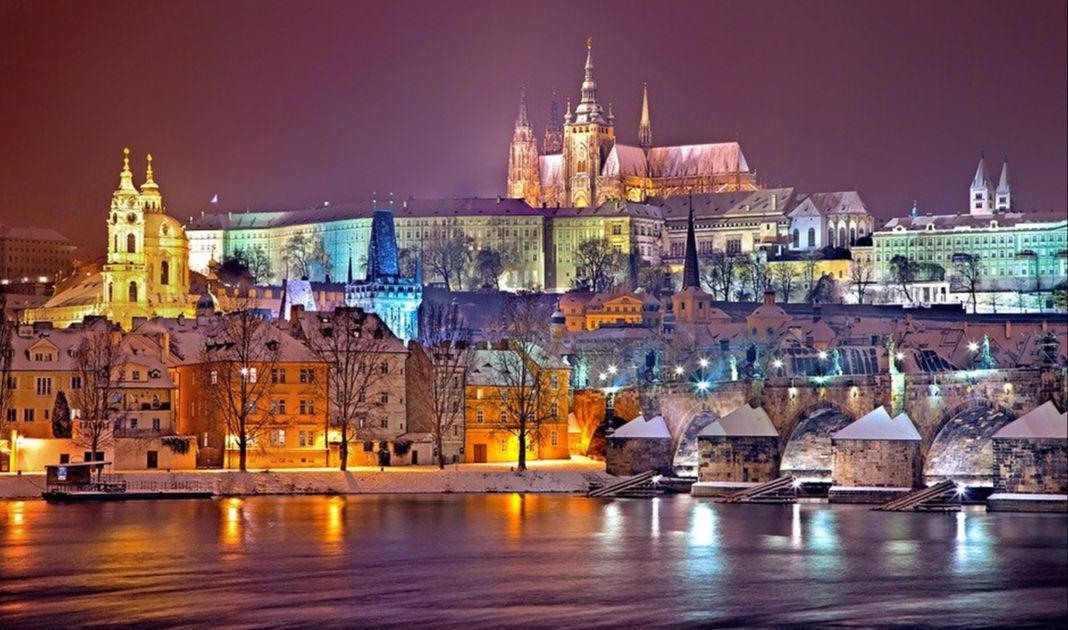
Praha (photo: Pixabay)
There are two most productive places in the world: Europe and East Asia.
Both of these places developed (independently of each other) based on imperial consolidation ambitions. We do not like to admit it today, but in the history of the world the “default imperial setting” is something natural. It has manifested itself in constant attempts to unite Europe (and China) in the framework of subsequent imperial projects from Antiquity and the early Middle Ages through modern times to the 20th century, repeating itself cyclically.
The history of empire building is the history of building infrastructure and roads, which supplies basic necessities and commodities to the system core, in return exporting highly processed products as well as security and political institutions. This is how empires are built – according to the well-known saying that “all roads lead to Rome.”
Roads are key because they enable the strategic flows on which trade and capital and investment penetration is based. Trade and investment generate growth the most. Trade, in particular, is the heart of economic expansion. Although I am not sure if we Poles know this, because we are too far away from the wonderful trade routes of the Atlantic – we have never become a “trading nation”.
The empire’s growth comes from two sources: a) organizing the space and managing its resources by expanding it or expanding its capital and organizational impact, and b) introducing new inventions (technologies) that change the economic system, monopolizing the benefits for the empire for some time.
The first way is easier: it is enough to expand territories and subject them to capital and organizational impact of the core, remove barriers to free trade and investment, enlarge the market and the number of hands to work new territories, and ensure freedom of capital flows to organize and exploit new spaces. This was the way the European Union was enlarged to include other countries.
The second way is more difficult. It needs investment, a spirit of innovation, and good fortune, although good fortune has probably been very favorable in this matter for Europe in the last 200 years. After all, the industrial revolution took place on the old continent, and its fruits over the next few decades led to European domination over the world. Earlier it used to be different.
From 1980 to around 2010, however, the first model in Europe was definitely the “expansion” model. Consolidation of successive peripheries took place. In the European empire, which in time came to embrace the countries of Central and Eastern Europe, Southern Europe and the Iberian periphery (Spain and Portugal), further community regulations were introduced in the field of telecommunications, finance, agriculture or fisheries, to name a few. All in line with the consolidation movement heading in one direction: “ever closer union”.
No empire was ever built with someone else’s money, so Europe had to have money. That money was the German mark. This happened sort of automatically, because Germany was unrivaled in productivity, and German bonds gave better yields. Germany simply became the strongest country. German unification only consolidated this phenomenon. After the introduction of the euro, Germany reaped its harvest at a low investment loan cost and financial cost. Admittedly, the economies associated with the German economy also benefited from low financing costs. The European Empire grew wonderfully and was based on the German brand. Then, as Louis Gave so eloquently writes, the French – who were losing power in the political system of European communities – stepped in with the idea of euro in order to somehow control Germany’s economic strength and growing influence in Europe.
After 20 years, the effects can be seen. They were not visible at first, because the European empire expanded in territory and the needs associated with it multiplied. That was good for economy. This resulted in economic expansion into new places and that increased the demand for capital. More people were saving in euros and local banks were lending more and more in euros.
After previous 30 years, the expansion of the European empire was halted as a result of major geopolitical shift hampering the process of ever-expanding European Union. As a result of Russia’s opposition, or in fact – blunt resistance, Georgia and Ukraine were not accepted, and the Balkans were becoming China’s and Russia’s playing field. The European Empire slowed down like a huge locomotive losing speed. Struck by the events that halted its expansion it fell to its knees, fatigued.
All in all, the European project is currently experiencing a crisis of equilibrium resulting from three simultaneous phenomena. The first concerns Europe’s loss of significance in the world. Europe has become a secondary place in terms of the dynamics of global processes and the balance of power. At the time of the revision of the world order, it turned out that “grammar of trade and diplomacy”, i.e. European soft power, is not enough. The second phenomenon destabilizing the balance in Europe is Russia’s attempt to regain influence in its western buffer zones.
The third structural phenomenon is the political, diplomatic and economic growth of Germany’s power in Europe. The previous balance was based on the German relationship with the Atlantic and the power of the world ocean (Westbindung) of Chancellor Konrad Adenauer and the transatlantic ties resulting from this geostrategic decision taken right after II World War. As a result of this decision and the establishment of the European Economic Community, Germany in a way lost indigenous control of the Ruhr area, and the European institutions mitigated German economic power.
A new situation began after the unification of the country in the 1990s and after the end of the Cold War. The enlargement of the EU and NATO to the countries east of the Oder river further strengthened Germany, giving them a security buffer from the east, which enabled the reduction of the standing army, a reorientation of expenditure and, generally speaking, reaping the “peace dividend”. Conditions for the eastwards economic and political expansion of Germany have been set up conveniently. In addition, as a result of the unification of the EU and the enlargement of NATO, not only did Germany’s security increase, but also strategic dependence on the United States decreased and their political and economic room for maneuver increased.
In the new system, Poland has become a buffer of security east from Berlin and an area of economic and capital expansion favorable to German economy’s interests. Economic dominance in the Eurozone achieved over time, a key role in European policy towards Russia (the issue of Crimea, Ukraine, sanctions) and the European financial crisis after 2008 led to the removal of the constraining “corset” from German policy on the continent.
The EU policy making architecture is currently being run through transmission belt of Germany’s geopolitical impact, affirming Prime Minister Margaret Thatcher’s warning that European communities are consolidating and strengthening Germany’s power rather than restraining it. It is enough to look at examples of Berlin’s behavior in the last 10 years towards Greece, Ireland, Italy, Portugal and Spain. The words of the German Finance Minister Wolfgang Schäuble are a testament here: “In Europe, we have a good reason not to provide financial assistance without asking for something in return and we do not help if the country is not using it to help itself”.
It is not surprising that its critics say that Germany has become the “China of Europe”, that their overarching goal is to maximize exports and keep labor costs below what they should be. The euro and its regime are, however, a regulatory “corset” for smaller countries, but not for Germany. Hungarian prime minister Viktor Orban went even further in criticism in 2015, accusing Germany of “moral imperialism”. The rise of German power has been duly noticed by Washington, which traditionally may end with actions aimed at balancing Germany’s power on the continent by the powerful USA.
The possible decision to significantly shift American troops stationing from Germany to Poland and the Baltic States, and in particular to establish their permanent presence east of the Oder and to reduce the US troops in Germany in general, will be such a signal (more than strengthening the overall potential for war with Russia on the NATO eastern flank) and this decision will certainly be read by Berlin, Moscow and Beijing as being intended to balance unwelcome German influence.
The decision-making elites of the “Old Union”, immersed in political stagnation, unable to grow further, are being tempted by the charm of “decolonization”. It would consist of getting rid of imperial peripheral possessions that in their thinking generate problems. Added to this is the geopolitical penetration by external forces of all the perimeters of the European empire: Russia in its eastern borders, US from the Atlantic, Turkey from Asian bridge, controlling the strategic flows of human masses from Africa and the Middle East to the Old Continent. And finally, Europe is not an island – the Mediterranean Sea separating the continent from the south is just a moat.
By the way, you can see that Europe no longer has a forward perimeter (as it used to) with its own military presence in North Africa and the Middle East to control what is happening there and block adverse phenomena impacting stability of Europe.
To make matters worse, the European empire has even lost its “soft power” charm. Brexit, the migration crisis, the possible end of the Schengen area, and protectionism – these do not provide the charm that the European empire was so proud of in the 1990s.
And at any moment another problem may surface. For the euro currency to be credible to investors, they must have the feeling that they will be paid back, i.e. that the authorities will collect taxes and return the money to investors. For this to happen and for all of this to be credible, governments in Western systems must have the legitimacy from society obtained in democratic elections. Meanwhile, in the political elites of the European Union in Brussels, technocrats rule. These are people who try to achieve the effect of their own legitimacy by treaties and not by voters’ votes. In real politics they are, as it turns out, of little value, because they cease to apply as soon as the balance of power or circumstances change. Hence the inflation of EU treaties in recent years. The constant attempts to “catch” the legitimacy. While in China this is done by alleged or explicit coercion, in the European Union it’s done by persuasion (for now), but largely undemocratic. Therefore, in the event of a conflict between vital national interests, national governments may ask who has the support of the real sovereign: them or Brussels.
It is not difficult to see, therefore, that the euro prevented people from having flexibility of having different labor productivity in Europe while there is no political will for financial transfers from the core to the periphery. Here, declared European solidarity breaks down, because there is not one European nation.
In 1975–2000 European industry compensated for German overperformance by devaluing the southern currencies, but now the euro corset means that adjustment can only take place through deflation and recession and this is happening. Hence the crisis of the south of the continent and the popularity of populist parties. The euro currency system has created a credit machine for German industry. If anyone left the eurozone, Germany would suffer a huge loss and be the victim of such a divorce.
In addition, China’s growing power, its economic penetration of Europe, and Chinese-American rivalry have given the European elites even more food for thought. And they should.
In the context of the European project, Poland has three ways forward. The first of these is associated with much closer cooperation with the US, with significant US geo-economic support based on an Intermarium construct that will contain and deter Russia. At the same time, this construct cannot be based only on military-defense matters, because it must change the economic structure so that Poland becomes a separate pole of strength (economically and militarily) for the region. Otherwise, it will still be only a “crush zone”, the subject and tool of competition between powers in this region of the world, playing their own interests and striving for a favorable balance for themselves.
In addition, the processes of division of the West may lead to a real breakup of the Atlantic community that has existed since 1945 and the emergence of increased competition for who sets the rules of the international game. They can also lead to increased competition from the Western powers of continental Europe for new Eurasian markets and for new political influence in Central and Eastern Europe. Then the US maritime power will need a “wedge” between the continental consolidation in Europe, Russia and China’s growing role in the region. The EU in its current shape will cease to exist, and Poland will choose to play for itself in cooperation with the USA.
Another way is the European continental project and the Warsaw “clinging” to the economy of continental Europe, in particular to Germany, and an attempt to make up for the time taken by history and the backward communist economy. This could be difficult, especially if the current world system continues to break down and the Americans will find themselves in conflict with “export” countries, i.e. China and Germany, as is expected. The trouble will then result primarily from the geographical proximity of Germany, which as the stronger economy will serve its business at the expense of ours, and will certainly give it priority over ours. However, it must be admitted that this option lies on the table and remains in the well-understood interest of Germany, therefore Berlin will listen to voices from Warsaw and at the same time fear American policy supporting European peripheries, such as the Three Seas project. Here there is room for maneuver for Warsaw on how to obtain concessions from Berlin and Washington at the same time and play them against each other.
The third way is the most theoretical, because we have never been faced with anything similar before. And anyway, in the current state of world affairs in the autumn of 2019 this already seems rather out of question. Namely – a path of “strategic flexibility” (a medium powers tend to choose such in times of major shifts) balancing US, German, European Union, Russian and Chinese influences by continuing cooperation with Germany and EU, opening up to cooperation on the Chinese New Silk Road, but without giving up the military alliance with the US. This is what most of US allies in the Pacific and Asia are currently doing. Location is of key importance here and it would be good not to be bypassed.
When deciding on this matter, the mental map of leaders will be of key importance because it is a new situation to which there is no historical reference. The mentioned geostrategic account in Eurasia with China’s growing dominance over Russia is different than during the Cold War. This is a completely new reality, unknown for over 300 years, i.e. since the time when Russia entered the imperial path, threatening the strategic interests and then the existence of Poland.
From all that is happening to the European project and the challenges facing the US, a serious crisis with Russia may ripen. Russia’s disintegration and total chaos similar to the situation after the Brest-Litovsk peace in 1918, including destabilization in buffer areas between Poland and Russia – in the Baltic States, Ukraine and Belarus are also possible. Poland, due to its vital national interests, must also have action plans in the event of such a scenario.
Europe on its knees can mean a protracted period of geopolitical decline. The continent may also become a trophy in the US-China clash. Whoever wins the clash of giants – the US with the Atlantic system or China with the new Eurasia – will become the core of a new system for which Europe may become a sheer periphery.
Then the current project of the European empire will remain mostly in our memories – as it has so often been for the last 2000 years.
Autor
Jacek Bartosiak
CEO and Founder of Strategy&Future, author of bestselling books.
 Strategy&Future


Trwa ładowanie...